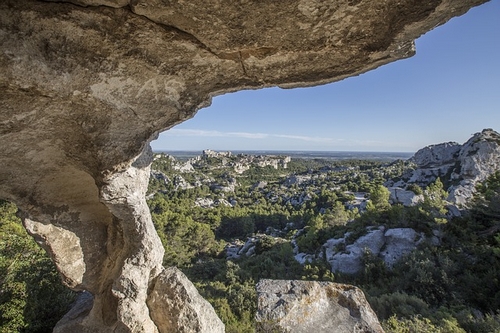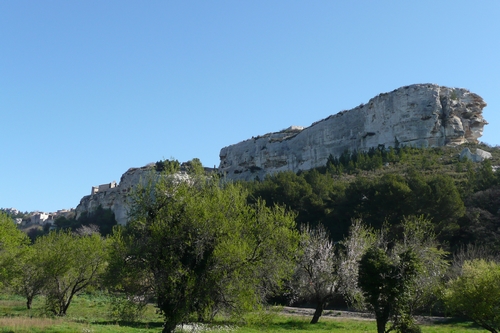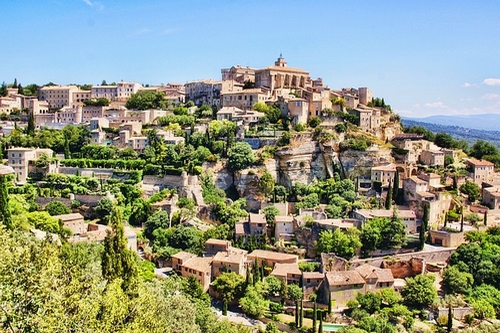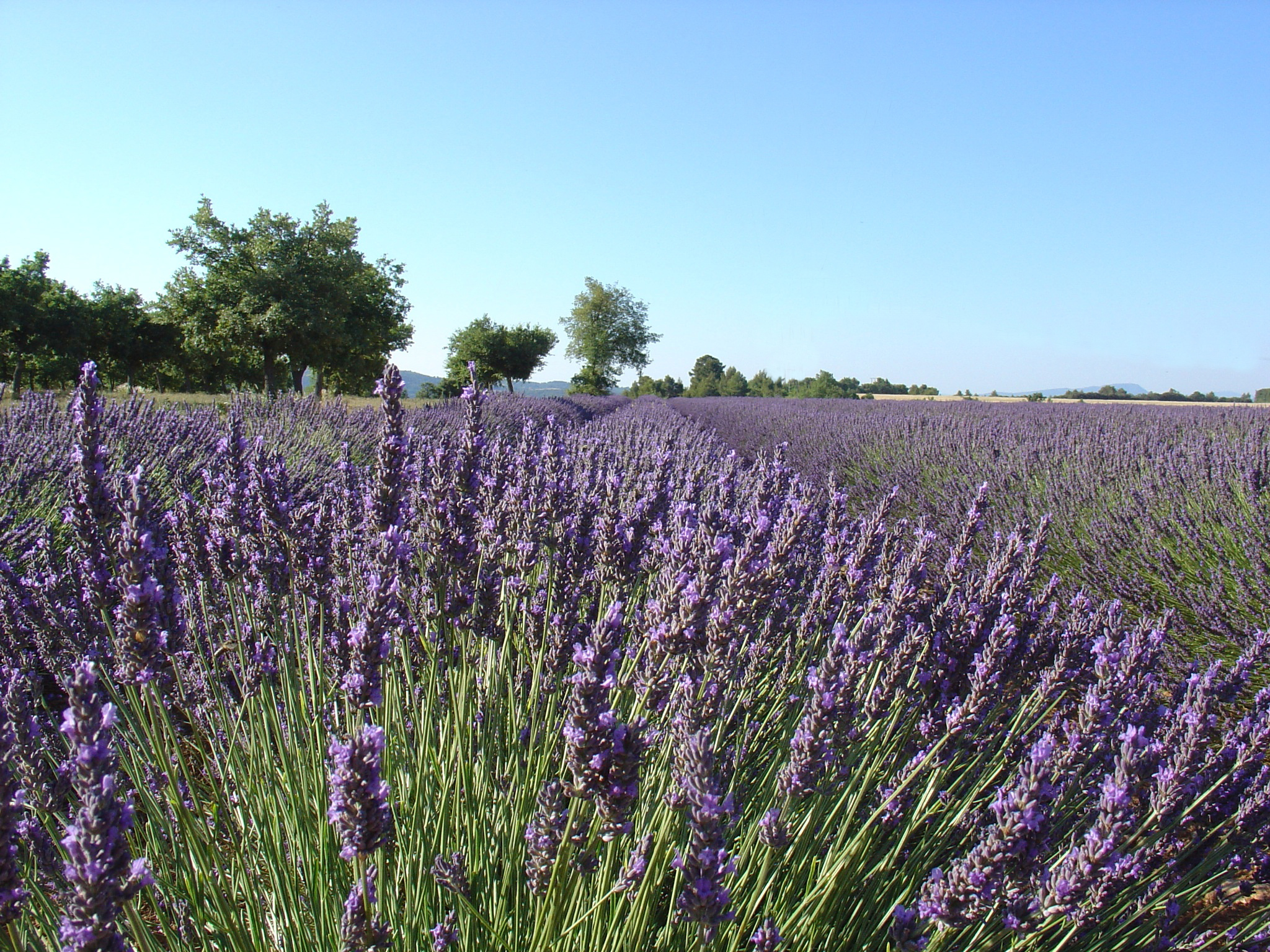
If the Luberon is the Provence of perched villages and lavender, the Alpilles are its luminous heart: a small massif of white limestone, bristling with jagged crests, planted with olive trees and cypresses, where the light has that mineral quality that kept Van Gogh awake at night. And of all the regions we share with our guests, it is the one closest to the Mas.
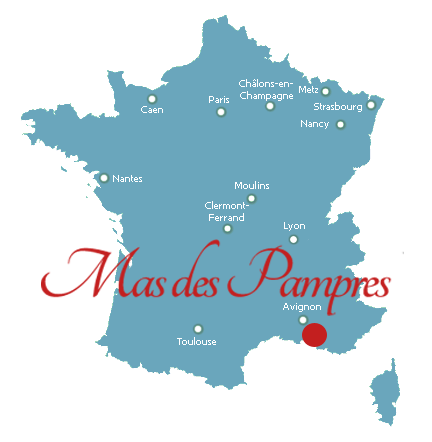
The Mas des Pampres sits at the northern foot of the Alpilles, in Cabannes. Saint-Rémy-de-Provence is a quarter of an hour away by car, Les Baux about thirty minutes. That is close enough to leave after breakfast, visit a site in the morning, return for a quiet lunch by the pool, and head out again in the afternoon — a comfort few rentals can offer.
For our English-speaking guests, the Alpilles will feel familiar even before you arrive: this is the landscape Vincent van Gogh painted during his year at Saint-Paul de Mausole — The Starry Night, the irises, the cypresses, the olive groves — around a hundred and fifty works in twelve months. It is also home to one of Provence’s most spectacular sights, the perched village of Les Baux and its immersive Carrières des Lumières. But to truly understand the Alpilles, you have to come — and stay long enough to watch the light change.
This page tells you everything you need to know to visit the Alpilles from the Mas: Saint-Rémy and the ancient city of Glanum, Les Baux-de-Provence and the Carrières des Lumières, the olive-oil country around Maussane and Le Paradou, the windmills of Daudet at Fontvieille, the quiet villages of Aureille and Mas-Blanc, and a detour to the Montagnette and the Abbey of Frigolet.
The map above places the Alpilles sites in relation to the Mas des Pampres. Click on each marker to see the driving time.
The Alpilles, 15 minutes from the Mas
The Alpilles form a small limestone massif about twenty kilometres long, between the Durance to the north and the plain of the Crau to the south, set between Avignon, Arles and Salon-de-Provence. Despite a modest altitude (the highest point, the Tour des Opies, reaches 498 metres), their white, abrupt crests give them the look of a miniature mountain range — hence their name, “the little Alps”. The massif has been a Regional Natural Park since 2007.
Above all, this is olive country. The Vallée des Baux-de-Provence has the highest density of olive trees in southern France, and its oil holds one of the country’s oldest protected designations of origin. It is also a land of garrigue, of thyme and rosemary, of white-stone quarries, and of villages that have kept their Provençal soul without the mass tourism of some of their neighbours.
From Cabannes, you reach Saint-Rémy in about fifteen minutes via the D99 then the D5. Allow about 30 minutes for Les Baux and Fontvieille, 25 minutes for Maussane and Aureille. Half a day is enough for one village; a full day to combine two or three nearby stops.
 Saint-Rémy-de-Provence — the capital of the Alpilles
A quarter of an hour from the Mas, Saint-Rémy-de-Provence is the living heart of the Alpilles: a village of art and history, set against the northern slope of the massif, where twenty-six centuries of heritage coexist with a genuine Provençal market-town life. You come for the market, for Glanum, for Van Gogh — and you return for the atmosphere.
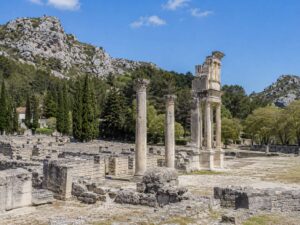 Glanum and the Antiques
At the southern edge of the village, on the road to Les Baux, the Plateau des Antiques announces one of the finest ancient sites in Provence. Two Roman monuments stand here in open access: the Mausoleum of the Julii, nearly 18 metres high and remarkably well preserved, and the triumphal arch, the oldest in Roman Gaul. They marked the entrance to Glanum, a Gallo-Roman city founded on a Celto-Ligurian sanctuary, whose excavations have revealed temples, a forum, baths, houses and a sacred spring. The site is open to visit (managed by the Centre des Monuments Nationaux) and deserves a good hour and a half.
In the footsteps of Van Gogh, at Saint-Paul de Mausole
Just beside Glanum, the monastery of Saint-Paul de Mausole — a jewel of Provençal Romanesque art with its 11th-12th-century cloister — has housed a sanatorium since the 18th century. It was here that Vincent van Gogh was a patient from 3 May 1889 to 16 May 1890, at his own request. During that year he painted with overwhelming intensity: The Starry Night, Irises, The Cypresses, wheat fields, the olive groves and the Alpilles themselves — around one hundred and fifty canvases. The visit of the cloister, the reconstructed bedroom and the garden is one of the most moving moments of a stay in the Alpilles. A walking trail lined with reproductions links the village centre to the monastery, on the very spots where the paintings were made.
The Wednesday market and the village
The Wednesday morning Provençal market is one of the largest and most renowned in Provence: it spills across all the squares of the old centre — fruit and vegetables, cheeses, olive oils, soaps, fabrics, pottery. Saint-Rémy is also the birthplace of Nostradamus, born here in 1503. Between two market stalls, take time to wander the lanes, step into the Musée des Alpilles or the Musée Estrine (which houses a Van Gogh interpretation centre), and enjoy a coffee in the shade of the plane trees.
Practical tips for Saint-Rémy
Parking: on Wednesday market day, arrive early (before 9.30am) — the central car parks fill quickly. The rest of the week, parking is far easier.
When to come:
→ Wednesday for the market, though it is the busiest day
→ Spring and autumn for Glanum and Saint-Paul without the heat or the summer crowds
→ Whit Monday: the spectacular Transhumance Festival, when several thousand sheep parade through the town
Good to know: Glanum and Saint-Paul de Mausole can be visited in the same half-day — they are five minutes’ walk apart, at the southern edge of the village.
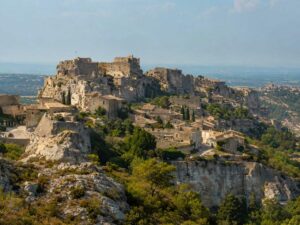 Les Baux-de-Provence — the perched village and the Carrières des Lumières
Perched on a rocky spur at the heart of the massif, Les Baux-de-Provence is one of the most spectacular sites in Provence — and one of the Plus Beaux Villages de France. The medieval village, built entirely from the white stone of the Alpilles, seems to grow out of the rock itself. Half an hour from the Mas, it is an essential stop.
The village and the château
You climb the cobbled lanes up to the Château des Baux, a vast ruined fortress overlooking the whole plain — on a clear day, the view reaches as far as the Camargue and the sea. Below, the village has kept its Renaissance houses, its chapels and its small squares. It is best visited early in the morning or late in the day: a magnificent place, but quickly saturated in the middle of the day in summer.
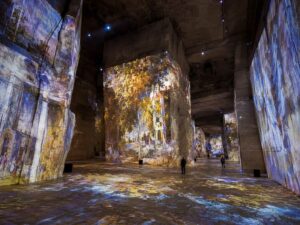 The Carrières des Lumières
A short walk from the village, in the hollow of the Val d’Enfer, former limestone quarries house the Carrières des Lumières: an immersive digital-art show in which works by great painters are projected, set to music, onto stone walls more than ten metres high. The site was the cradle, as early as 1977, of the Cathédrale d’Images conceived by Albert Plécy; today it is run by Culturespaces, which stages a new monumental exhibition there each year. It is a singular experience, particularly loved by families and striking in any season. Booking advised in high season.
Practical tips for Les Baux
Parking: several paid car parks at the foot of the village. In summer, come before 10am or after 5pm.
Combining: the village + the château + the Carrières des Lumières make a full, rewarding day. Plan the château in the morning (in the cool), lunch on site or at Le Paradou, and the Carrières in the afternoon (always cool — ideal during the hottest hours).
Did you know: the Val d’Enfer below is said to have inspired the landscapes of Dante’s Inferno, and Jean Cocteau filmed The Testament of Orpheus there.
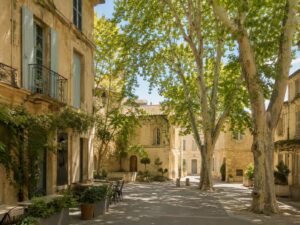 Maussane-les-Alpilles and Le Paradou — the land of olive oil
On the southern slope of the Alpilles, Maussane-les-Alpilles is the capital of Provençal olive oil. It is here, around its shaded square and its handsome fountain, that the heart of the Vallée des Baux beats — the valley with the highest density of olive trees in southern France.
The Moulin Jean-Marie Cornille, set in a vaulted 17th-century building and a cooperative since 1924, is an institution: its AOP olive oil of the Vallée des Baux-de-Provence, made from a blend of five local olive varieties, is multi-award-winning and recognised as a “Living Heritage Company” (Entreprise du Patrimoine Vivant). The shop and the permanent exhibition in the former olive lofts can be visited all year round — the finest gourmet souvenir to bring home from a stay.
Two kilometres away, the small village of Le Paradou has become a renowned gastronomic stop in the Alpilles, with a handful of tables worth the trip. It is also a convenient starting point for walks or bike rides through the olive groves, between Maussane and Fontvieille.
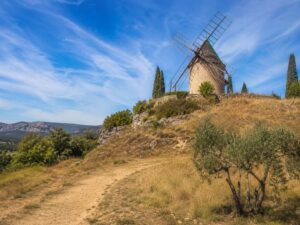 Fontvieille — the windmills of Daudet
West of the massif, Fontvieille is the village of Alphonse Daudet — or rather the one tradition has attached to him. On a pine-clad hill stands the Moulin de Daudet (the Moulin Ribet, also called Saint-Pierre, built in 1814), restored in 1935 by the Society of the Friends of Alphonse Daudet and turned into a small museum. The writer in fact never lived there: he stayed at the nearby Château de Montauban, and his Letters from My Windmill were written elsewhere — but it is here that their spirit is best felt. A pleasant windmill trail (about an hour) links the village’s four windmills and the château.
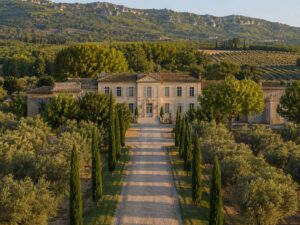 On the edge of the village, on the road to Maussane, the Château d’Estoublon is a superb 18th-century wine and olive estate: a long avenue of cypresses leads to the château, its chapel and its rose garden, and you can taste the olive oils and wines of the Vallée des Baux there. The park and its walking paths are freely accessible. Nearby too, the Moulin de la Coquille — named after the curious sculpted rock that marks the site — completes the picture of this peaceful countryside.
For the curious: a few kilometres to the south, the remains of the Roman aqueduct and flour mill of Barbegal bear witness to an extraordinary ancient hydraulic complex — one of the largest mills in the Roman Empire.
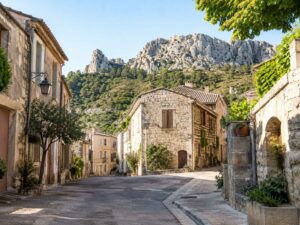 Aureille and Mas-Blanc-des-Alpilles — the quiet villages
For those who love Provence without the crowds, two villages are worth the detour on either side of the massif.
Aureille, to the east of the Alpilles, is an authentic Provençal village crowned by the ruins of its medieval castle. Far from the tourist bustle, it is an excellent starting point for hiking and mountain biking in the wildest part of the massif, among olive groves and garrigue. You still find here the feel of a real village, with its square, its café and its olive-oil producers.
Mas-Blanc-des-Alpilles, just a few minutes from Saint-Rémy (and therefore very close to the Mas), is one of the smallest communes in the Alpilles: a peaceful hamlet at the foot of the northern slope, ideal for a quiet stroll and for reaching the trails of the massif on foot or by bike.
The Montagnette and the Abbey of Frigolet
Set apart from the Alpilles proper, between Avignon and Tarascon, the Montagnette is a small range of hills covered with pines, olive trees and fragrant garrigue — its name, “the little mountain”, says much of its modest charm. It is a detour we love to suggest, off the beaten track, about twenty minutes from the Mas.
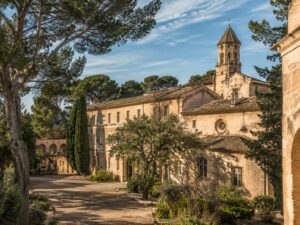 In the hollow of a valley hides the Abbey of Saint-Michel de Frigolet, home to a community of Premonstratensian canons (the “white canons”). Its name comes from the Provençal ferigoulo, thyme. Behind its neo-medieval, fortress-like walls hide a startling basilica entirely painted from floor to ceiling and the baroque chapel of Notre-Dame du Bon Remède, decorated with a gift from Queen Anne of Austria. The abbey is also famous for its Frigolet liqueur, a beautiful golden-green, distilled from the plants of the Montagnette — the “elixir of the Reverend Father Gaucher” that Alphonse Daudet made famous in his Letters from My Windmill. A lovely wink that closes the loop with the windmills of Fontvieille.
The ideal one-week itinerary in the Alpilles
If you are staying for a week at the Mas des Pampres and want to devote most of your time to the Alpilles, here is how we suggest you organise your days. This is an indicative itinerary, to be adapted to your rhythm and your interests — you may also simply choose one or two stops and enjoy them fully.
See our day-by-day itinerary
Day 1 — Saint-Rémy and Glanum
Morning in Saint-Rémy (market if it is Wednesday), lunch on a terrace, afternoon at Glanum and Saint-Paul de Mausole. Back to the Mas for the pool and apéritif.
Day 2 — Les Baux-de-Provence
Château des Baux in the cool of the morning, lunch in the village or at Le Paradou, Carrières des Lumières in the afternoon. Back to the Mas for dinner.
Day 3 — Maussane and the olive-oil country
Quiet morning at the Mas. Visit and tasting at Moulin Cornille in Maussane, lunch at Le Paradou, a walk through the olive groves in the afternoon.
Day 4 — Fontvieille and the windmills of Daudet
The windmill trail in the morning, Château d’Estoublon and a tasting, lunch on site. A relaxed afternoon at the Mas.
Day 5 — Market and pool
Wednesday market in Saint-Rémy (if your stay allows), back to the Mas for lunch and a restful afternoon.
Day 6 — The Montagnette and the Abbey of Frigolet
A detour to the Montagnette: a visit to the Abbey of Frigolet, a walk through the garrigue, lunch in Barbentane or Boulbon.
Day 7 — Aureille and the eastern Alpilles
To finish, the wilder Provence: Aureille, hiking or mountain biking in the massif, lunch in the village. Evening at the Mas.
This itinerary is indicative. Many of our guests prefer to slow the pace and devote a whole day to a single place. On arrival, we will hand you our personal address book with the good tables, the producers worth visiting, and the walks we have discovered over the years.
Good addresses and tables of distinction in the Alpilles
The Alpilles are home to some of the finest tables in Provence. Here are a few addresses we recommend (reservation essential, sometimes months in advance in high season — and do check opening days, which vary by season):
L’Oustau de Baumanière in Les Baux-de-Provence (30 min) — the great gastronomic table of the Alpilles, in an exceptional setting at the foot of the village. For a memorable lunch or dinner.
La Cabro d’Or in Les Baux-de-Provence (30 min) — the more relaxed table of the same house, in a magnificent garden. Ideal for a lunch in the shade.
Le Bistrot du Paradou in Le Paradou (25 min) — a Provençal institution with a single daily-changing menu, in an authentic bistro atmosphere. Reservation essential.
A fine table in Saint-Rémy (15 min) — the village has several very good addresses, including a Michelin-starred one, a step from the market. Perfect to round off a day of visits.
And of course, our personal address book contains the more confidential addresses too — the small olive-oil producer who only receives by appointment, the riverside guinguette, the wine merchant in Saint-Rémy who knows every grower in the area. Those addresses, we prefer to share with you on arrival, in person.
Book a stay at the Mas to explore the Alpilles
The Mas des Pampres is ideally located for exploring the Alpilles at your own pace. A quarter of an hour from Saint-Rémy and half an hour from Les Baux, you reach every site in the massif with ease while enjoying a true country house in peace — a balance few rentals offer in this much-sought-after region.
Our 400 square-metre house, with its seven bedrooms and large 5,000 square-metre walled garden, is particularly well suited to extended family stays or groups of friends who want to take the time to truly get to know the region — not just pass through it.
A note on the ideal seasons for the Alpilles:
→ April-May: spring, garrigue in bloom, mild temperatures, fresh light. Ideal for Glanum, Les Baux and walking.
→ June and September: peak season without the August crowds, pleasant terraces, golden light.
→ October-November: the season of the olive harvest and the new oil, quiet villages, autumn colours.
→ December: nativity scenes, santons and Provençal Christmas traditions, an intimate atmosphere.
To discover the rest of the region, see also our page dedicated to the Luberon and our complete activities page, which covers Avignon, Arles and the rest of Provence.
For any enquiry:
Mireille & Pierre Taton
Telephone: +33 (0)6 22 30 18 90
Email: contact@masdespampres.fr
→ See availability and rates