 If one region of Provence captures the country exactly as you imagine it — honey-coloured stone, lavender fields stretching to the horizon, villages perched on their hilltops, terraced vineyards — it is undoubtedly the Luberon. And of all the parts of Provence, it is the one we most love to share with our guests.
The Mas des Pampres is ideally located right at the edge of the Luberon, which means you can leave in the morning for Gordes or the Abbey of Sénanque, and return in the evening to watch the sunset from our terrace. Within thirty minutes by car, you reach what is arguably one of the most beautiful cultural landscapes in France.
This page tells you everything you need to know to visit the Luberon from the Mas: the essential villages, the Abbey of Sénanque, the spring of Fontaine-de-Vaucluse, the Ochre Trail of Roussillon, the loop of the perched villages, and the good addresses we don’t share everywhere.
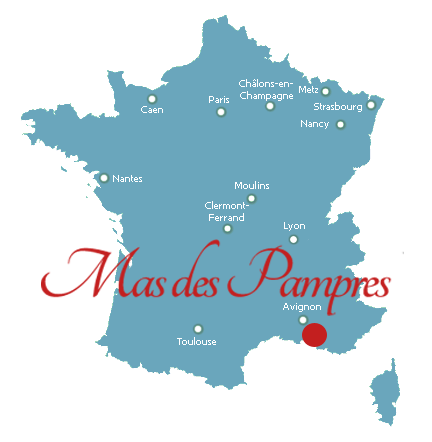
The map above places the Luberon villages in relation to the Mas des Pampres. Click on each marker to see the driving time.
The Luberon, 30 minutes from the Mas
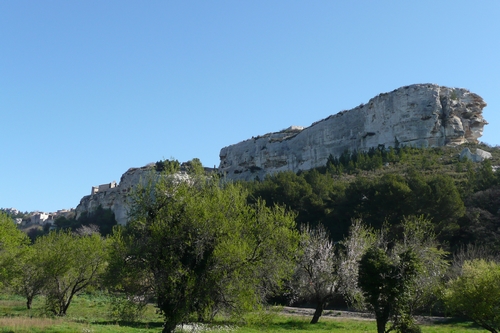
The Luberon is a limestone massif stretching for 60 kilometres between Cavaillon in the west and Manosque in the east, straddling the départements of Vaucluse and Alpes-de-Haute-Provence. Designated a Regional Natural Park in 1977, it brings together 76 communes and 175,000 inhabitants, in a landscape shaped since the Neolithic by shepherds, winemakers, olive growers and dry-stone builders.
Tradition distinguishes the Petit Luberon in the west (around Cavaillon, Ménerbes, Lacoste, Bonnieux) from the Grand Luberon in the east (around Apt, Saignon, Cucuron). For your first days of exploration, it is the Petit Luberon that will welcome you most readily — this is where the most iconic and most accessible villages are found.
For our English-speaking guests, the Luberon may already feel familiar even before you arrive. It is the Provence that Peter Mayle made famous to the anglophone world in A Year in Provence (1989), written from his home in Ménerbes; the landscape of Ridley Scott’s A Good Year (2006), filmed largely at Bonnieux and Château La Canorgue; and the setting of countless documentaries, travel magazines and lifestyle books over four decades. But to truly understand the Luberon, you have to come — and stay long enough to see it change from one season to the next.
From Cabannes, you reach the heart of the Luberon by taking the D2 then the D900 — a peaceful road that follows the Durance, crosses Cavaillon, and disappears into the vines towards the hills. Allow about 35 minutes for Gordes, 40 minutes for the Abbey of Sénanque, and 35 minutes for Roussillon. Half a day is enough to discover one village; a full day to combine two or three.
Gordes — one of the most beautiful villages in France
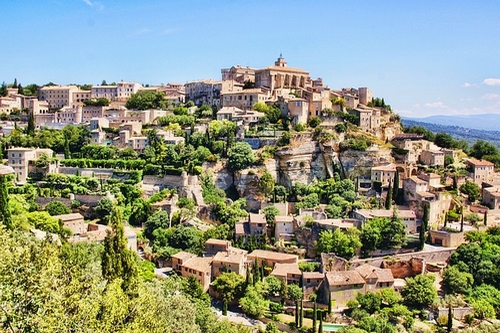
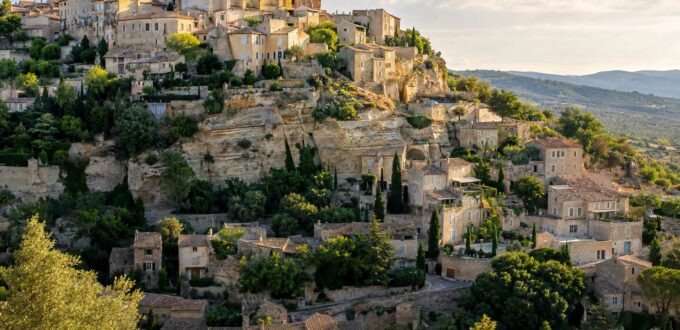
If you only had to visit one village in the Luberon, it would be Gordes. Listed among the Plus Beaux Villages de France, it was even voted the most beautiful village in the world by the American magazine Travel + Leisure in 2023, ahead of Shirakawa-go in Japan and Giethoorn in the Netherlands. Perched at around 340 metres on a limestone promontory of the Monts de Vaucluse, it is also one of the most photographed in the country — you will instantly recognise its silhouette: honey-coloured houses cascading down, dominated by the Renaissance château and the church of Saint-Firmin.
What to do in Gordes
The village is discovered on foot, by wandering through its cobbled lanes, known here as calades. Several stops are worth your time:
The Renaissance Château dominates the main square. Built in the 11th century and remodelled in the Renaissance, it now hosts temporary exhibitions.
The vaulted cellars beneath the tourist office: six underground rooms from the 12th century, once used for olive-oil pressing and wine storage. A short visit (15 minutes) but striking, to grasp the medieval life of the village.
The Pol Mara Museum, dedicated to the Flemish painter who lived in Gordes for thirty years. Small but intimate collection, ideal for an hour between two walks.
The Tuesday morning Provençal market, one of the most iconic in the region. Local producers, cheeses, olive oils, seasonal fruits, Provençal textiles — a chance to fill your basket for the week and chat with the stallholders.
The Bories Village, two kilometres outside Gordes: a hamlet of restored dry-stone huts, a striking witness to the pastoral architecture of the 17th-18th centuries. Half an hour of visit — surprising and moving.
Practical tips for Gordes
How to park, when to come, where to take the best photos
Parking: the centre of the village is pedestrianised. Three free car parks at the foot of the village — allow 10 minutes’ walk up to the château square. In high season (July-August), arrive early in the morning (before 10am) or in the late afternoon.
Best moments to visit:
→ April-May and September-October: ideal light, few visitors, pleasant terraces
→ Mid-June to mid-July: to combine with the lavender at Sénanque
→ December: Christmas market, illuminations, near-empty village
→ To avoid: 14 July to 20 August, the village is saturated between 11am and 5pm
The best viewpoint of Gordes is not actually in the village: it is on the D15 road between Gordes and the Abbey of Sénanque, about 800 metres from the village. A small belvedere on the right offers the postcard panorama — the cascading houses, the château, the church. Ideal at sunset.
The Abbey of Sénanque — the lavender season
Five kilometres from Gordes, at the bottom of a hidden valley, the Abbey of Notre-Dame de Sénanque offers one of the most recognisable images of Provence: a Cistercian monastery from the 12th century, still inhabited by a small monastic community, framed by fields of purple lavender.
The abbey was founded in 1148 by monks from the Abbey of Mazan, in Ardèche. Together with its two Cistercian sisters in Provence — Le Thoronet and Silvacane — it is regarded as one of the finest examples of primitive Cistercian architecture: bare stone, pure lines, an absence of ornamentation. The art of austerity in the service of contemplation.
The lavender bloom
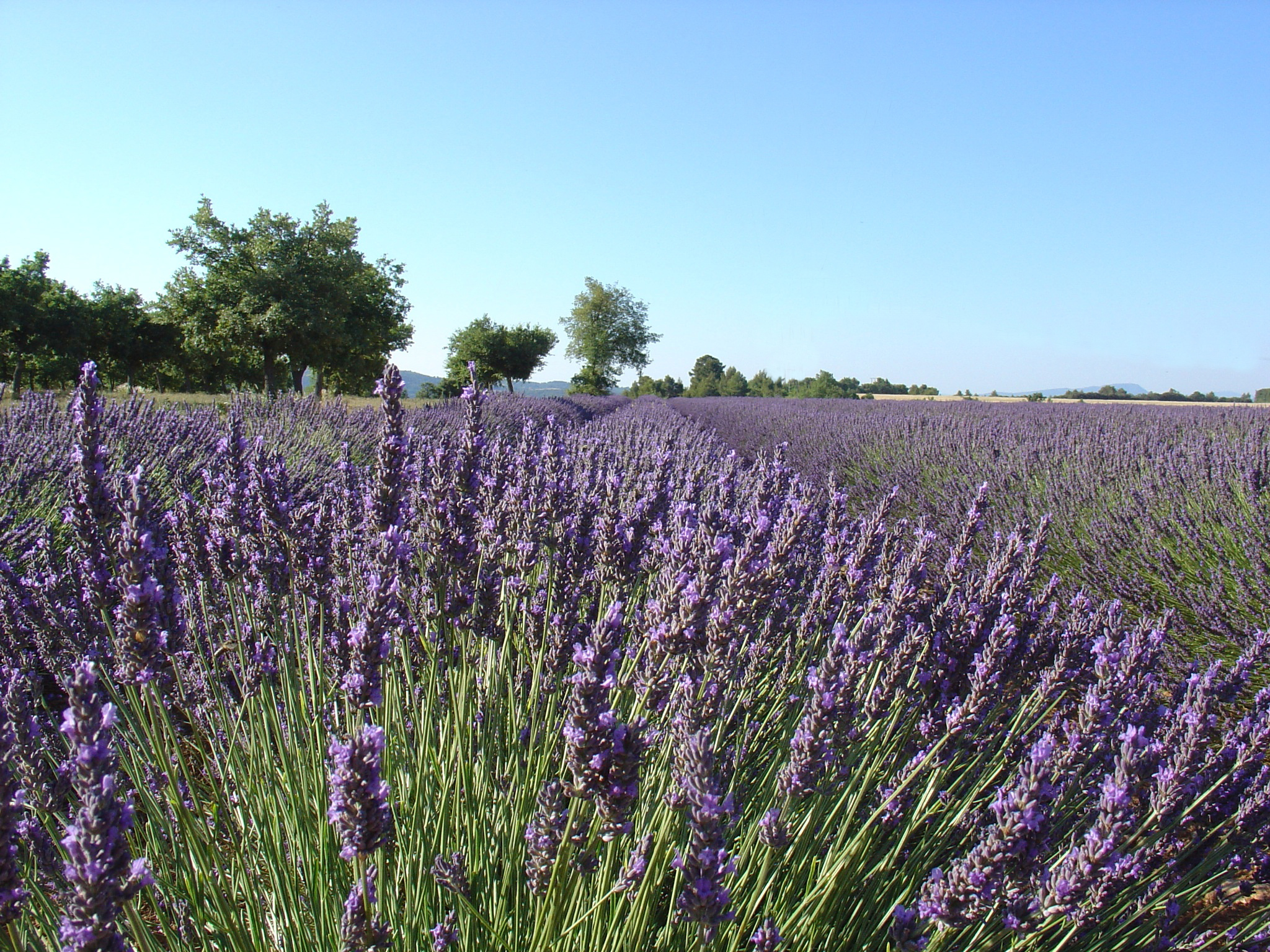
The lavender bloom at Sénanque happens each year from mid-June to mid-July, peaking generally around 5-15 July. The exact dates vary with the preceding winter and spring — a few days earlier in a mild year, later in a cool or rainy one.
This is undoubtedly the most magical moment to discover the abbey, but also the busiest. If you come at this time, we recommend arriving before 9.30am or after 5pm to avoid the crowds (and find a space in the small car park).
Outside the bloom, the abbey remains superb to visit — the fields are then green, then brown depending on the month, but the silence of the place and the beauty of the stone alone are enough to justify the trip.
Visiting the abbey
The abbey can be visited only on guided tours, in French, by reservation, outside the religious offices. The tour lasts about an hour and includes the abbey church, the cloister, the chapter house, the dormitory and the refectory. Reservation essential in high season via the abbey’s official website. Most anglophone visitors find the tour rewarding even without French — the visual experience and the atmosphere speak for themselves.
The monastic offices (lauds, mass, vespers, compline) are open to the public — attending a mass or vespers in the abbey church is an experience in itself, free of charge, accessible without reservation.
The monastic shop sells the community’s products: essential oil of lavender, honey, liqueurs, books. A beautiful gift to bring home from your stay.
Fontaine-de-Vaucluse — the largest spring in France
On the edge of the Luberon, about twenty minutes from Sénanque, the village of Fontaine-de-Vaucluse is home to one of the most spectacular natural phenomena in Provence: the source of the Sorgue, which surges up at the foot of a high cliff in a rocky amphitheatre. It is the largest spring in France by flow, and the fifth largest in the world — a karst chasm whose bottom, reached at more than 300 metres deep, long kept its mystery.
In 2024, the site joined the prestigious list of the 200 IUGS Geological Heritage Sites (International Union of Geological Sciences), a distinction made official at the 37th International Geological Congress in South Korea. Its flow has been recorded without interruption since 1878, making it the most thoroughly studied spring in the world — to the point that hydrogeologists everywhere speak of a “Vauclusian-type” spring to describe the phenomenon.
The spectacle varies with the seasons: dramatic and surging during snowmelt and after rain (the flow can then exceed 80 m³/s), calmer in summer when the level drops. The village itself rewards a stroll — the Vallis Clausa paper mill (traditional handmade paper-making), the Petrarch museum recalling the Italian poet’s stay, and the terraces set along a Sorgue of translucent green. Easily combined with L’Isle-sur-la-Sorgue, ten minutes away.
Roussillon and the Ochre Trail
East of Gordes, Roussillon is unique in its kind: the only village in the Vaucluse built entirely from red ochre. Vibrant façades, lanes in shades of orange, spectacular panoramas over the Apt countryside — Roussillon is a village you do not forget.
The Ochre Trail
A short walk from the village, the Ochre Trail takes you into a former open-pit quarry, in a magnificent landscape of fairy chimneys, red cliffs, orange sands and green pine groves. It is a marked, secure route, ideal for families.
Two loops to choose from: short circuit (30 minutes, 700 metres) or long circuit (50 minutes, 1.5 kilometres). The long is more complete, the short is sufficient for a first discovery. Closed shoes are essential — ochre stains light clothing permanently (also bring something to protect children’s outfits).
The trail is open all year round. Moderate fee (around €4 per adult, free for children), payable at the entrance. In high season, arrive early in the morning or late in the afternoon to avoid the crowds and enjoy the best light on the ochres.
The Conservatory of Ochres and Colour
Two kilometres from Roussillon, the Okhra — Conservatory of Ochres and Colour, housed in a former early 20th-century pigment factory, tells the fascinating story of ochre extraction in the Vaucluse. Free visit of the industrial site, painting workshops for adults and children, shop of pigments and brushes. An intelligent complement to the trail visit — allow one and a half hours on site.
The village of Roussillon
The village itself deserves an hour’s stroll. Gently sloping lanes, vibrantly coloured façades, shady terraces in summer, artists’ studios open to the public. The Castrum, at the top of the village, offers a 360° panorama over the Apt country, Mount Ventoux to the north, and the Alpilles range to the south-west.
The Roussillon Provençal market takes place on Thursday morning on the Place de la Mairie — smaller than the Gordes one but of high quality.
Bonnieux, Ménerbes, Lacoste — the loop of the perched villages
About ten kilometres south of Gordes, three villages rise along the slopes of the Petit Luberon: Bonnieux, Ménerbes and Lacoste. All three classified among the Plus Beaux Villages de France, they form an ideal loop to explore at leisure over a day — by car, by electric bike for the more sporty, or even on foot along the GR97 long-distance path for experienced walkers.
Bonnieux — the belvedere of the Luberon
Bonnieux is one of the largest villages in the Luberon, tiered along the northern flank of the mountain. Its high church, built in the 12th century, occupies the summit — to reach it, you must climb the long stone staircase, but the panorama from its esplanade is well worth the effort: at 180°, you embrace the entire Luberon, the Apt country, and on clear days the Alpine peaks in the distance.
The village is also known for its Friday morning market, its Museum of Bread (set in a 17th-century house), and several remarkable contemporary art galleries. For film lovers: many scenes of A Good Year (Ridley Scott, 2006) were shot here and at Château La Canorgue just outside the village.
Ménerbes — the House of Truffle and Wine of the Luberon
Ménerbes is perhaps the most discreet of the three villages, but also one of the most moving. Stretched along a rocky ridge, this is where the English writer Peter Mayle lived and wrote A Year in Provence (1989) — the book that introduced an entire generation of anglophone readers to the Luberon. This is also where the Maison de la Truffe et du Vin du Luberon (the House of Truffle and Wine) is located.
Housed in the former mansion of Astier de Montfaucon, this institution combines a library, a tasting cellar bringing together the great wines of AOC Luberon (70 estates represented), and a gastronomic restaurant in high season. Tastings possible all year round, on site or to take away — the chance to discover the great whites of the Luberon, which are among the most elegant in Provence.
Also at Ménerbes, do not miss the Corkscrew Museum (Musée du Tire-Bouchon) at Domaine de la Citadelle: 1,200 corkscrews collected across three centuries, beautifully curated, and a fine tour of the wine estate that houses it.
Lacoste — the Cardin Château and the art school
Lacoste, more modest in size, owes its fame to its ruined château — that of the Marquis de Sade, who lived there in the 18th century. The château was bought in 2001 by the couturier Pierre Cardin, who partially restored it and now hosts each summer a well-regarded performing arts festival (theatre, opera).
The village also hosts a branch of the Savannah College of Art and Design (the American art school), which explains the presence of young international artists in the lanes — a rather unique cosmopolitan atmosphere for a Provençal village.
The ideal one-week itinerary in the Luberon
If you are staying for a week at the Mas des Pampres and want to devote most of your time to discovering the Luberon, here is how we suggest you organise your days. This is a suggested itinerary, to be adapted to your rhythm and your interests — you may also simply choose one or two stops that appeal to you and enjoy them fully.
See our day-by-day itinerary
Day 1 — Gordes and the Bories Village
Morning in Gordes (arrive by 9.30am to enjoy the calm), lunch on a village terrace, afternoon at the Bories Village. Back to the Mas in the late afternoon for the pool and apéritif.
Day 2 — Abbey of Sénanque + Fontaine-de-Vaucluse + L’Isle-sur-la-Sorgue
Morning at Sénanque (guided tour at 10am or 11am depending on the season), lunch at Fontaine-de-Vaucluse beside the spring, afternoon at L’Isle-sur-la-Sorgue (canals, antique dealers, floating market on Sundays).
Day 3 — Roussillon and the Ochre Trail
Quiet morning at the Mas. Leave around 11am for Roussillon, lunch in the village, afternoon on the Ochre Trail + Conservatory Okhra. Back to the Mas for dinner.
Day 4 — The Bonnieux-Ménerbes-Lacoste loop
A full day exploring the three villages at a leisurely pace. Lunch stop in Bonnieux or Ménerbes. Tasting at the House of Truffle and Wine in the afternoon.
Day 5 — Gordes market and an afternoon by the pool
Tuesday morning Provençal market at Gordes (if your stay runs Saturday to Saturday). Back to the Mas for lunch, a relaxed afternoon.
Day 6 — Apt and the Grand Luberon
A day in the eastern Luberon: Saturday morning market at Apt, visit to Saignon or Cucuron, lunch on a terrace, afternoon at your own pace.
Day 7 — Saint-Rémy-de-Provence
To finish the week, a day closer to the Mas: Saint-Rémy in the morning (15 minutes), Glanum in the afternoon.
This itinerary is indicative. Many of our guests prefer to slow the pace and devote a whole day to a single village, to linger without hurry. On arrival, we will hand you a good address book with restaurants, the producers worth visiting, and the quiet walks we have discovered over the years.
Good addresses and tables of distinction in the Luberon
The Luberon is a major destination for Provençal gastronomy. Here are a few institutions we recommend (reservation essential, sometimes months in advance in high season):
La Bastide de Gordes in Gordes (35 min) — Five-star hotel-restaurant with exceptional views over the village. Michelin-starred cuisine in an extraordinary setting. For a memorable lunch or dinner.
Capelongue in Bonnieux (45 min) — Maison Beaumier, Provençal signature around the produce of the kitchen garden and the Luberon hills. One Michelin star.
La Coquillade Provence in Gargas (45 min) — A magnificent wine estate and high-end resort with several tables on site, including a Michelin-starred one. An exceptional setting for a tasting lunch.
Auberge La Fenière in Cadenet (50 min) — Historic house founded by Reine Sammut, taken over by her daughter Nadia. Michelin-starred cuisine and Michelin Green Star for its local and gluten-free commitment.
Domaine de la Citadelle in Ménerbes (35 min) — More accessible, the estate offers a simple menu built around the wines of the domain, in a superb setting overlooking the Calavon Valley. Ideal for a lunch before visiting the Corkscrew Museum.
And of course, our personal address book contains the more confidential addresses too — the small family inn at Lourmarin that no one knows, the winemaker at Lacoste who only receives by appointment, the baker at Bonnieux who makes the best olive fougasse in the Luberon. Those addresses, we prefer to share with you on arrival, in person.
Book a stay at the Mas to explore the Luberon
The Mas des Pampres is ideally located for exploring the Luberon at your own pace. Within half an hour of the iconic villages, you avoid the inconveniences of staying inside the Luberon itself (difficult parking, saturated restaurants, higher rental prices in classified villages) while benefiting from easy access to every site.
Our 400 square-metre house, with its seven bedrooms and large 5,000 square-metre walled garden, is particularly well suited to extended family stays or groups of friends who want to take the time to truly get to know the region — not just pass through it.
A note on the ideal seasons for the Luberon:
→ April-May: spring, wild flowers, awakening gardens, mild temperatures, fresh light. Ideal for walking.
→ Mid-June to mid-July: the lavender season at Sénanque. The best moment for photography.
→ September-October: vendange season, golden light, terraces still pleasant at lunch, quiet villages.
→ December: intimate Christmas markets, Provençal traditions, a unique atmosphere.
To discover the full range of activities accessible from the Mas, see also our complete activities page, which covers the Alpilles, Avignon, Arles and the rest of Provence.
For any enquiry:
Mireille & Pierre Taton
Telephone: +33 (0)6 22 30 18 90
Email: contact@masdespampres.fr
→ See availability and rates